

Your Wedding Ceremony Music Checklist for a Mallorca Wedding
Choose the meaningful songs, confirm how they will be performed and turn the plan into a clear ceremony cue sheet.
In this guide
- 1. Confirm your ceremony's shape before choosing every song
- 2. Choose songs for the meaning and the arrangement
- 3. Write down who is performing and what is live
- 4. Plan entrances around real movement
- 5. Complete a ceremony music cue sheet
- 6. Check sound, position and practical access
- 7. Agree the weather and technical alternatives
- 8. Make a final handover, then stop changing the plan
Your ceremony music can be simple and still feel deeply personal. One meaningful entrance, a carefully chosen moment of reflection and a joyful exit may be all you need. The important work is deciding what happens, how the music will sound and who gives each cue.
This wedding ceremony music checklist takes you from first ideas to a practical plan for a destination wedding in Mallorca. Use it with your partner, celebrant or officiant, venue, planner and musicians. It does not assume that every ceremony contains the same elements: include only the moments that belong to yours.
1. Confirm your ceremony’s shape before choosing every song
Ask the person leading your ceremony for the proposed order. Establish which parts are fixed, which are optional and where music can sit naturally. Check any restrictions or approval requirements directly with the officiant and venue, particularly if the ceremony takes place within a religious service or a space with its own conditions.
List the likely musical moments without filling them all automatically. A ceremony does not need a song under every action. Words, pauses and the sounds of the setting can have their own place. Decide whether you want music to introduce a moment, accompany it or provide a short transition afterwards.
- Guest arrival and seating, with background music if wanted.
- Entrance of the wedding party, if applicable.
- The couple’s entrance, together or separately.
- A signing or reflective moment, if it forms part of the ceremony.
- An optional musical contribution or ritual agreed with the officiant.
- The recessional: the couple’s exit and guests leaving the ceremony area.
Your first decision is therefore about structure, not taste. Once the order is clear, it is much easier to give each song a purpose.
2. Choose songs for the meaning and the arrangement
Build a short reference playlist together and note why each piece matters. Read the lyrics in full, including verses you may never have noticed in the radio version. If guests use different languages, consider whether you want to share a brief explanation in your order of ceremony rather than expecting every person to understand the words.
Then listen beyond the original recording. A song with a large orchestral introduction may feel quite different with guitar and voice. A familiar upbeat number can become intimate when performed more slowly. Ask what an available arrangement would involve before deciding it is right for a particular entrance.
Record the song title, reference artist and specific version. “The acoustic one” is not enough if several recordings exist. Where a live interpretation is planned, confirm its general pace and structure and discuss any passage that carries special meaning. A reference recording helps communicate your preference; it does not establish that the live version will copy it exactly.
3. Write down who is performing and what is live
Be precise about the musical configuration. A solo singer means one vocalist; it does not, by itself, tell you whether the accompaniment is a live instrument, recorded backing or no accompaniment. A duo means two performers, but you still need to know their roles and instruments.
For a singer with recorded backing, ask who supplies and operates the tracks and how the performance can adapt if an entrance takes longer than expected. For live accompaniment, ask how the musicians will handle a delayed start or a longer signing moment. Put the chosen live or recorded arrangement clearly on the quote and cue sheet.
When exploring wedding ceremony music with Maya, confirm the actual vocal and accompaniment arrangement for your date. Use the same precise description on the quote, running order and final cue sheet so that everyone plans around the same performance.
4. Plan entrances around real movement
Plan how you will walk down the aisle as carefully as the song itself. Identify where people will wait, how far they will walk and whether there are stairs, turns, doors or a pause before the aisle. Ask who will organise the waiting group and who can see both the entrance and the musicians.
Choose a clear readiness signal. It might come from the planner after checking that the photographer, officiant and wedding party are ready. Avoid using a guessed clock time as the only instruction: the music should not begin while someone is still searching for a bouquet or helping a guest into their seat.
If you want the entrance to coincide with a lyric, discuss how achievable that is with the arrangement and route. A rough walk-through can help establish the pace. Allow a natural ending rather than planning to stop a live singer abruptly halfway through a phrase.
5. Complete a ceremony music cue sheet
Copy this blank cue sheet into your planning document. Leave out rows that do not apply and add a separate row whenever a new cue is needed. The cue column should identify an action or named responsibility, not simply say “when ready”.
| Moment | Song and version | Format | Cue and contact | Ending or backup |
|---|---|---|---|---|
| Guest arrival | To confirm | Live / recorded | Start window and contact | How to finish before the entrance |
| Wedding party entrance | To confirm, if used | To confirm | Who signals; who enters | What happens if someone pauses |
| Couple’s entrance | To confirm | To confirm | Readiness signal and contact | Agreed musical ending |
| Signing / reflection | To confirm, if used | To confirm | Officiant or coordinator’s cue | Shorter or longer version |
| Exit | To confirm | To confirm | Exact words or action giving the cue | Continue for guests leaving? |
| Move to reception | To confirm | To confirm | Who takes over in the next space | Prepared handover option |
Keep essential pronunciation notes and song changes alongside this sheet. Put a version date at the top and nominate one person to collect final amendments. A short, accurate document is more useful during the ceremony than a long message thread.
6. Check sound, position and practical access
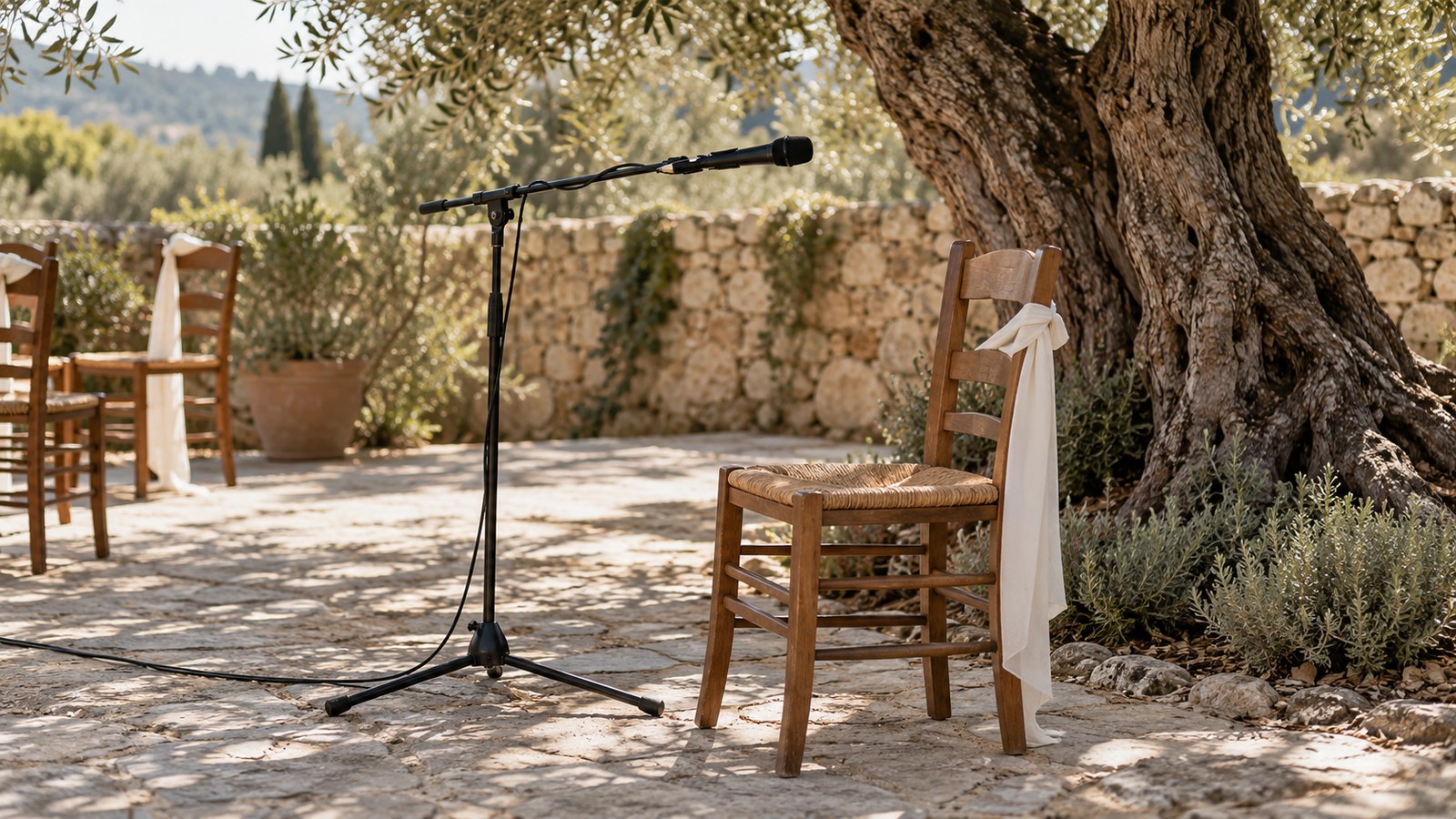
Ask the venue and musicians to agree the performance location together. It should allow useful sightlines for cues, appropriate sound for the guest seating and safe space around equipment. A spot that looks attractive in a photograph may be unsuitable for cables, power, direct sun or the path used by arriving guests.
Clarify whether amplification is required and who supplies it. Separately confirm how the officiant and any readers will be heard. Do not assume that a singer’s sound system includes the right microphones or someone to operate them for every speaker.
Share the venue’s actual access and sound requirements, including setup times, loading arrangements, any limiter and rules for the chosen ceremony area. Ask when the sound check will finish so it does not clash with guests taking their seats. If the celebration moves elsewhere afterwards, establish whether another system is needed there.
7. Agree the weather and technical alternatives
An outdoor Mallorca ceremony deserves a workable alternative, even when you hope not to use it. Ask the venue which space would be used, who decides to move and by what point the musicians need to know. A different room can change the equipment layout, aisle length and visibility of cues.
Discuss practical shelter, wind, heat and electrical safety with the venue and supplier. Do not assume an umbrella or a last-minute move will protect instruments or make an unsuitable space usable. The alternative needs to be agreed before the day.
For essential recorded tracks, establish who holds the correct files, who operates playback and what the backup is. For live music, ask what happens if a performer cannot attend or equipment fails. These arrangements belong in the supplier’s agreed scope rather than in a hopeful instruction to “have something ready”.
8. Make a final handover, then stop changing the plan
Place the ceremony within your wider wedding music timeline so the final cue leads naturally into the drinks reception and the rest of the day.
Before the agreed song deadline, send the finished cue sheet to the musicians and the person coordinating the ceremony. Confirm spellings, versions, timings and any request that needs preparation. Ask for confirmation that the document matches what has been booked, including song-learning arrangements and additional charges where applicable.
Tell the photographer and videographer about meaningful musical moments, particularly an entrance cue or a short solo contribution. Ask your suppliers who needs permission for recording or sharing a performance; treat those arrangements separately from simply hiring the musicians.
Finally, check how your ceremony flows into the reception. If you are considering a lounge duo for drinks, allow for the actual people, equipment and movement involved. If you would like Maya to sing at your ceremony, share your date, venue and ceremony outline so the conversation can begin with your music and accompaniment preferences.
The best wedding ceremony music checklist leaves you with a few confident choices: the right songs, a clear performance arrangement, visible cues and a practical alternative. Once those are agreed, the music can support the ceremony without asking you to manage it from the aisle.
Your ceremony, your songs
Give the moment its own music.
Tell us about your ceremony, date and venue, along with the songs and accompaniment you would like to explore with Maya.
"*" indicates required fields