

Your Mallorca Wedding Music Timeline: From Ceremony to Last Dance
A practical guide to shaping the sound of your wedding day, with an adaptable schedule, clear handovers and room for the unexpected.
In this guide
- Build the day around moments, not a list of songs
- An example wedding music timeline
- Guest arrival: let the atmosphere settle
- Ceremony: use a cue sheet, not guesswork
- Drinks reception: give conversation room
- Dinner and speeches: plan the quiet moments too
- First dance and party: make the handover intentional
- Build in buffers and a realistic weather alternative
- Send one clear final running order
A good wedding music timeline does more than say when the band starts. It gives each part of the day its own atmosphere, protects the moments you want to hear clearly and helps everyone move between spaces without an awkward pause. For a destination wedding in Mallorca, it also connects the music with transport, the meal, the light and the venue’s arrangements.
Start with the feeling you want: an intimate ceremony, relaxed conversation over drinks, a warm dinner and a dance floor that opens with purpose. Then work backwards from your confirmed ceremony time, catering schedule and permitted finish. Use the example below as a starting point, then adapt it to your venue, suppliers and celebration.
Build the day around moments, not a list of songs
Before choosing individual tracks, mark the moments that need music and the moments that need attention. Guests arriving is one musical job; a processional is another. A singer accompanying drinks is different from a band opening the evening party, even when some of the same musicians are involved.
Write down where each moment happens, who is responsible and what must be ready beforehand. If your ceremony, drinks and dinner occupy three separate areas, the technical plan needs to account for all three. Equipment cannot simply be assumed to follow guests instantly, and the time musicians spend moving or checking sound is not performance time.
Give one person authority to call the important cues. This might be your planner, coordinator or another agreed contact. They should know when the ceremony entrance is ready, when speeches are about to begin and when dinner is running late. Several helpful people giving different instructions can create more confusion than a modest delay.
An example wedding music timeline
This illustrative schedule assumes a 17:00 ceremony. Adjust it to the season, venue, travel arrangements and shape of your celebration. A later ceremony does not automatically require every later element to move by the same amount: the kitchen and venue may have fixed boundaries.
| Example time | Moment | Music and coordination |
|---|---|---|
| 16:30 | Guests arrive | Welcome music; ceremony system already checked. |
| 17:00 | Ceremony | Agreed entrance, optional signing moment and exit cues. |
| 17:30 | Drinks reception | Conversational live music or a prepared playlist in the next space. |
| 19:00 | Guests move to dinner | Clear handover; music ready before the first guests sit down. |
| 19:30 | Wedding breakfast | Background music around service; a deliberate pause for speeches. |
| 21:30 | First dance and evening opening | Confirmed version of the song and an agreed cue into the next number. |
| 22:00 onwards | Evening celebration | Contracted live sets, planned break music and a confirmed finish. |
The useful part of this table is the sequence, not the clock. Keep a working version with your suppliers, then issue a concise final version when the operational details are settled.
Guest arrival: let the atmosphere settle
Arrival music welcomes people before anything formal begins. Choose a mood that belongs to the ceremony rather than trying to make an early statement. A gentle instrumental selection or restrained vocal performance can leave space for greetings, seating instructions and the anticipation of the entrance.
Confirm when the first guests could arrive, not only the printed invitation time. Ask where drinks, shade and seating will be available and how the musician will see the coordinator. Keep the final pre-ceremony minutes flexible: the arrival music should be able to finish naturally when everyone is ready.
Ceremony: use a cue sheet, not guesswork
For each entrance, agree the song, exact arrangement and person giving the signal. An original recording, a live acoustic interpretation and a piano-and-vocal arrangement may have very different introductions. If a specific lyric matters, ask how the entrance can be shaped around it rather than assuming a walk will last exactly the same length as the recording.
Discuss any signing or reflective moment with the celebrant or officiant and check what is actually part of your ceremony. Some moments are optional; others may not suit a musical interlude. Decide how the exit begins, including whether the celebrant’s final words or the couple’s first movement provides the cue.
Our ceremony music page is a starting point for exploring this part of the day. For the final plan, specify whether the singer has live accompaniment, recorded backing or another agreed arrangement.
For a song-by-song plan, use our wedding ceremony music checklist to record the versions, cues and people responsible.
Drinks reception: give conversation room
After the ceremony, the energy usually opens out. Guests greet the couple, photographs begin and drinks circulate. Music can bring these activities together, but it should still suit people meeting and talking. Tell your musicians whether you imagine an understated backdrop or a more prominent performance with moments of audience attention.
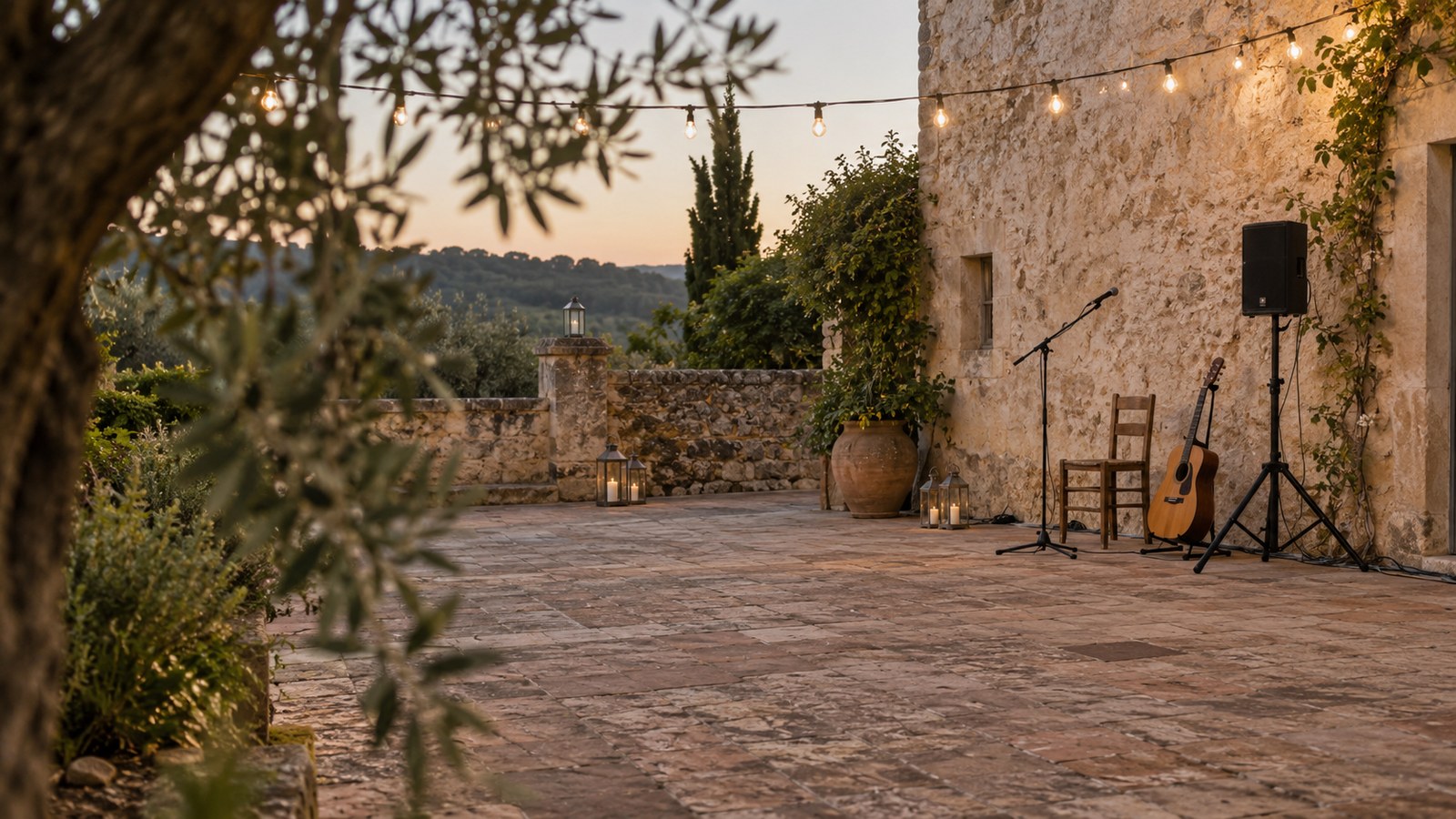
Consider where guests will actually gather. A beautiful corner away from the bar may leave the performance disconnected from the reception. Positioning, shade, suitable power and the route used by staff all matter. Agree these details with the venue before fixing the performance location.
If a duo suits your plans, look at the lounge and acoustic duo direction and ask for the exact two performers, instruments and recorded elements. A name such as “sunset session” describes a mood; it does not establish a line-up or its duration.
Dinner and speeches: plan the quiet moments too
The wedding breakfast needs its own volume and pacing. Music that feels comfortable beside the bar can compete with conversation at a dining table. Ask who will assess the sound from the guest seating, especially if loudspeakers serve several different areas.
Our guide to wedding breakfast music explores the balance between a welcoming atmosphere, comfortable conversation and the practical rhythm of dinner.
Mark speeches clearly and tell the person controlling the music who will introduce each speaker. Confirm microphone arrangements separately from the musical performance. A musician’s vocal microphone is not automatically a suitable roaming speech microphone, and it may be in a different space when needed.
Allow the catering team to guide the practical sequence. Avoid locking a live set to the exact minute a main course is expected to finish. A sensible plan identifies an approximate window and explains who can adjust it, within the supplier’s contracted hours.
First dance and party: make the handover intentional
Choose whether your first dance will use a live arrangement or a particular recording. Confirm the version, start point, ending and any planned invitation for other guests to join. If you are practising at home, use the version that will be heard on the day or ask for enough detail to understand the arrangement.
Then decide what happens immediately afterwards. The next song can help guests feel that the evening has opened, while a pause for instructions can pull attention elsewhere. Discuss the transition with your musicians and planner rather than leaving it as an unassigned gap.
For a wedding party band, record the number and length of live sets, the breaks and who supplies music between them. A live band, a recorded playlist and a DJ are distinct services. Confirm which are included and who is responsible for the final song.
Build in buffers and a realistic weather alternative
A useful timeline allows the celebration to breathe. Add room around guest movement, photographs and catering, and ask suppliers how a delay would affect their work. An arrival delay may shorten a reception set or require a different handover; it should not silently turn into an expectation of unlimited extra time.
For outdoor plans, agree an alternative performance position and a decision point with the venue. Discuss shelter, wind, heat, access and electrical arrangements with the people responsible. The indoor option needs a music plan too, including space, power, guest capacity and any venue-specific sound conditions.
Check the rules for your actual venue and date: permitted music locations, any sound limiter, outdoor restrictions and the finish time. Obtain the venue’s instructions directly and share them with the musicians. Do not rely on a general statement about what weddings in Mallorca usually do.
Send one clear final running order
Your final version should show times, locations, musical moments, cue contacts, speech pauses, live sets, breaks and the finish. Add the agreed first-dance version and any essential song notes, then keep long wish lists in a separate document. Everyone should know which version is current.
A strong wedding music timeline gives your suppliers enough detail to coordinate while leaving you free to enjoy the day. Begin with the moments that matter most, confirm the practical boundaries and let the musical choices grow from that structure.
If you would like Maya to sing at your wedding, share your date, venue and the moments that matter most. We can then discuss the music and accompaniment you have in mind.
Your wedding, your music
Plan the music around your day.
Share your date, venue and outline timetable, and tell us how you would like Maya’s voice to feature in the moments that matter most.
"*" indicates required fields